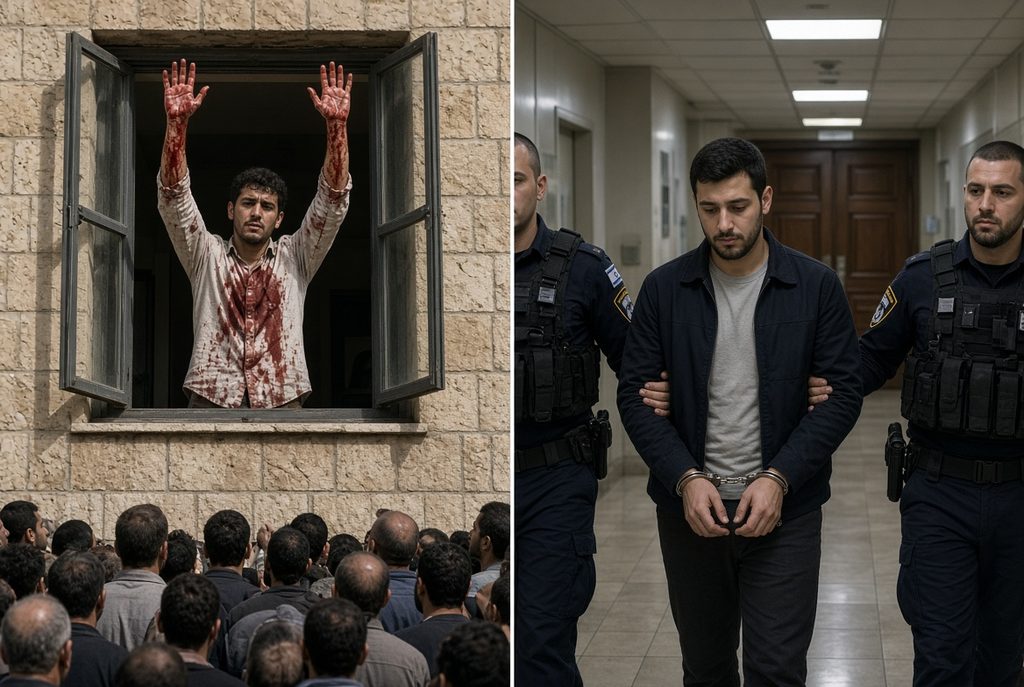
Twelve Israel Prison Service guards have been charged with reckless homicide and aggravated assault over the November 2023 death of Thaer Abu Asab at Ketziot. Abu Asab, a Fatah member already serving 25 years for attempted murder, died after an alleged group beating. The indictment describes batons, kicks, a ruptured heart, broken ribs, and an attempt by some of the accused to align their stories. That is not a press release. It is a docket in the Beersheba District Court.
In Judea and Samaria, Israeli police and the Shin Bet keep arresting Jewish teenagers and young men for nationalist attacks: burned cars, clubs, stones, arson. Three suspects after a Tulkarm-area assault and vehicle burning. Three teens after the Jaba attack. Six defendants, five of them minors, indicted in 2026 on terror-related arson charges after Deir Dibwan, including fire near a mosque. The charges are conspiracy, arson, aggravated assault, sometimes “act of terrorism.” The suspects sit in Israeli cells, not on a balcony receiving congratulations.
That is the pattern critics call “impunity.” Look at the actual sentences.
Amiram Ben-Uliel murdered the Dawabsheh family in the 2015 Duma arson. An Israeli court gave him three life sentences plus 20 years. Jack Teitel, the “Jewish serial killer,” received two life sentences plus 30 years. The 1980s Jewish Underground members who murdered students at the Islamic College in Hebron were convicted of murder and membership in a terrorist organization; the killers received mandatory life. Yigal Amir is still in prison for assassinating Yitzhak Rabin. These are not rumors. They are Israeli judgments against Israeli Jews for nationalist murder.
Even wartime vandalism is treated as a crime. In April 2026 an IDF soldier in the Christian village of Debel, southern Lebanon, took a sledgehammer to a statue of Jesus. Another soldier filmed it. The IDF confirmed the photo, called the conduct a deviation from its orders and values, dismissed both from combat duty, and sent them to 30 days in military prison. Six others who stood by were summoned. The army replaced the statue. Weeks later another soldier put a cigarette in the mouth of a Virgin Mary statue in the same village; he got 21 days, the photographer 14. Netanyahu said he was stunned. The chief of staff called it a moral failure. That is what happens when an Israeli soldier smashes a sculpture on camera.
There is no official public census titled “Jews currently serving time for nationalist terror.” The closest figures come from the people who want those prisoners freed. In late 2025 a coalition letter asked the president to pardon Jewish inmates convicted of murder, arson and racist attacks. Honenu, which represents many of them, spoke of “a few dozen,” including convicts, pre-trial detainees and people on community service. The president’s office said it had received more than 30 pardon requests for Jewish security prisoners. A “few dozen” is not zero. It is also not a martyr roster on the evening news.
Yesh Din, which monitors settler-violence files, says that from 2005 through 2024 about 94 percent of the investigations it tracked closed without indictment and only about 3 percent ended in a full or partial conviction. That number is real and it is damning if the question is whether every price-tag attack is punished. It does not erase the cases that do end in life sentences, multi-year terms, military jail, dismissal from combat, and current indictments of prison officers. A low hit rate is a law-enforcement failure. It is not a doctrine of celebration.
Now the other ledger.
October 7 was planned slaughter: roughly 1,200 murdered, rape, burning, 251 hostages. Hamas later called it a “glorious day of success.” Officials filmed themselves thanking God. West Bank streets handed out sweets. PA-linked officials called it pride and a dream come true. Schools staged speeches and drawings of the paragliders. Years later the language has not been withdrawn. The Palestinian Authority’s payments to imprisoned attackers and to families of those killed while attacking Israelis—the system critics call pay-for-slay—were still being described by the U.S. State Department in 2026 as continuing under rebranded “welfare” channels, tens of millions of dollars a year. That is not a rogue teenager with a lighter. That is a political culture that prices murder and throws a party when it works.
Put the two systems next to each other.
Israel investigates its prison guards, charges them, and puts Jewish murderers in for life. It jails soldiers for smashing a statue and replacing the statue the same week. It arrests settler kids and writes “terrorism” on the indictment. Enforcement is uneven. Files close. Politicians grandstand. Every free country can do better, and Israel is no exception.
The other side writes monthly checks to the people who kill Jews, teaches the massacre in school, and calls the worst day in Israeli history a glorious success. That is not a gap in policing. That is the opposite of a criminal code.
One society treats its thugs as criminals and then argues about whether the sentence was long enough. The other treats far worse acts as public virtue. That difference is not an Israeli talking point. It is the difference between a state that still has prosecutors and a movement that still has a martyr fund.
If you want this cut for length, I can collapse the Yesh Din paragraph into two sentences and keep the named lifers + statue case + pay-for-slay as the spine.